In rural Drenthe, more people are now employed in the leisure industry than in agriculture1. Hybrid forms such as agritainment offer an alternative to further upscaling. Through billboards, web platforms, and television, a carefully constructed image of the region emerges, focused on experiences in nature, productive landscapes, and theme parks.
In Landscape and Power, W.J.T. Mitchell describes landscape as both product and packaging, a real place and a simulacrum at the same time. From this perspective, I explored—together with artists, residents, and visitors—other ways of experiencing and shaping the recreational landscape. After all, “recreation” literally means “re-creation.”
The title of the presentation is derived from The Laws of Imitation by the French sociologist Gabriel Tarde (1843–1904), who argued that innovation arises through imitation—each adaptation is copied and passed on. During the presentation, a monotone computer voice read passages from Tarde’s book, while the exhibition revealed various forms of imitation: representation, simulation, appropriation, and mirroring.
Within the exhibition, different forms of imitation could be identified, including representation, simulation, appropriation, registration, and mirroring. The artists presented both “real places and simulacra,” and played with company regulations, copyright, and codes of conduct.
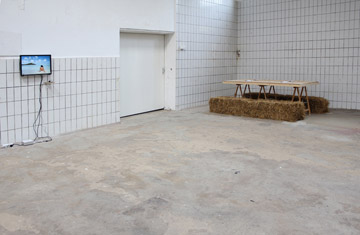
By playing with regulations, rules, and behavioural codes, the artists explored how images and meanings are produced and how they can be redirected. Pilvi Takkala’s Real Snow White shows her confrontation with Disneyland security guards over what is real and what is fake; in Jennifer in Paradise, Constant Dullaart highlights the first photograph ever edited with Photoshop; in The Others, Semâ Bekirovic filmed a picnic for animals; in Floor Meijers’ To Work, we see men in suits rushing through grassland; and Dullaart’s Crystal Pillars reflected on social structures within digital networks.

Visitors could participate in Tenigma by Malcolm Kratz, a game derived from Tangram in which collaboration is essential. In The Library, books and clippings were placed on tree trunks as an invitation to read, make connections, and engage in conversation.

During the public programme days, lectures, workshops, walks, and guided tours of the exhibition took place. Critic Saskia Monshouwer gave a talk in the Library; forager Leah Groeneweg organised a wild-foraging meal; filmmaker Pablo Núñez developed a workshop on landscape film for young people; and I myself, in collaboration with Judith Omvlee, led the children’s workshops Time Travel in the Drenthe Landscape.
Beneath the former factory chimney, now a telecommunications mast, an audio recording by eco-philosopher Timothy Morton could be heard, calling for a reinvention of our thinking about nature and technology. No easy task. But as Tarde noted in The Laws of Imitation: by repeating and adapting old ideas, we eventually do come to think differently.
This project was made possible with the support of the Mondriaan Fund and Stichting KIK. Thanks go to the participating artists and to all other contributors for their input, support, and assistance.
1. Facts and Figures on the Leisure Economy in Drenthe, print edition 2013, published by the Province.